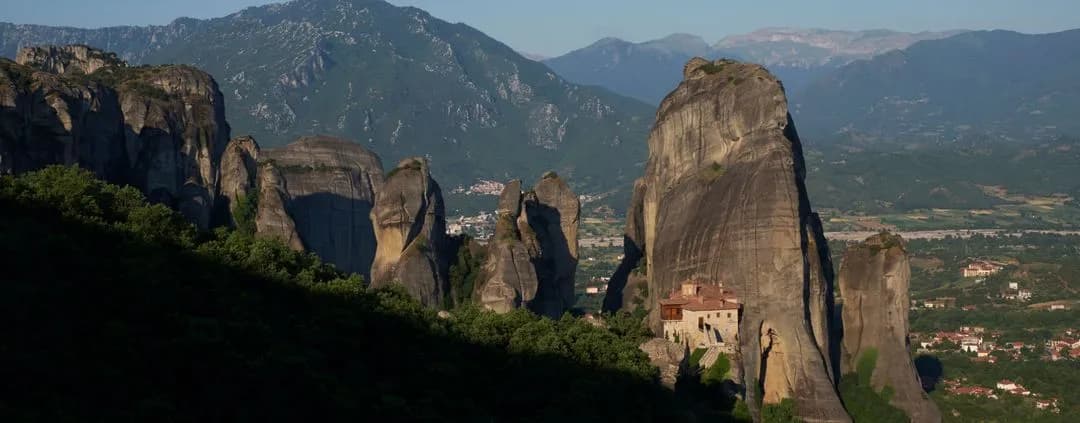
In his book Meteora (1882), Polykarpos Rammides, a former abbot of the Monastery of Great Meteoron, writes (although without quoting any source) that the rock of Roussanou was first inhabited in 1388 by the hieromonk Nikodimos and his fellow ascete Benedict, who asked the abbot or Proton (denoting ‘first’) of the Scete of Stagoi for his permission to build a church of the Transfiguration.
For about for one hundred and forty years after this the rock of Roussanou lay deserted, falling under the jurisdiction of the monastery of Great Meteoron.
The first historically confirmed reference is found in the Chronicle of Meteora, which states that in 1527 only one layman lived in the deserted monastery.
The monastery was founded by two brothers and hieromonks from Ioannina, Joasaph and Maximos, who, at some point between the years of 1527 and 1529, obtained permission to settle and live the monastic life on the pillar of Roussanou.
In 1545 the founders compiled a written testament, taking as models the testaments of St Bessarion II, Metropolitan of Larissa, and the founders of the monastery of Varlaam. In this document the brothers give an account of how the monastery was built and developed.
We know very little about the buildings that already stood there when the founders arrived. There would have been a main church or katholikon, as well as a few ancilliary buildings and monastic cells, but in a parlous state.
As soon as they settled there they set about building. They rebuilt the old Church of the Transfiguration, which lay in ruins, from the foundations. They built monastic cells and other ancillary buildings. They set about making the monastery self-sufficient by planting vineyards, establishing gardens, building mills, and introducing livestock. They acquired for the monastery liturgical vessels and vestments, manuscripts and other ecclesiastical artefacts. They established a strict coenobitic rule, taking their personal struggles as a prototype for the ascetic life.
Finally, they defined the monastery’s relations and obligations towards the Bishop of Stagoi and the abbot of Great Meteoron, whose jurisdiction extended only to the spiritual oversight of the monastery.
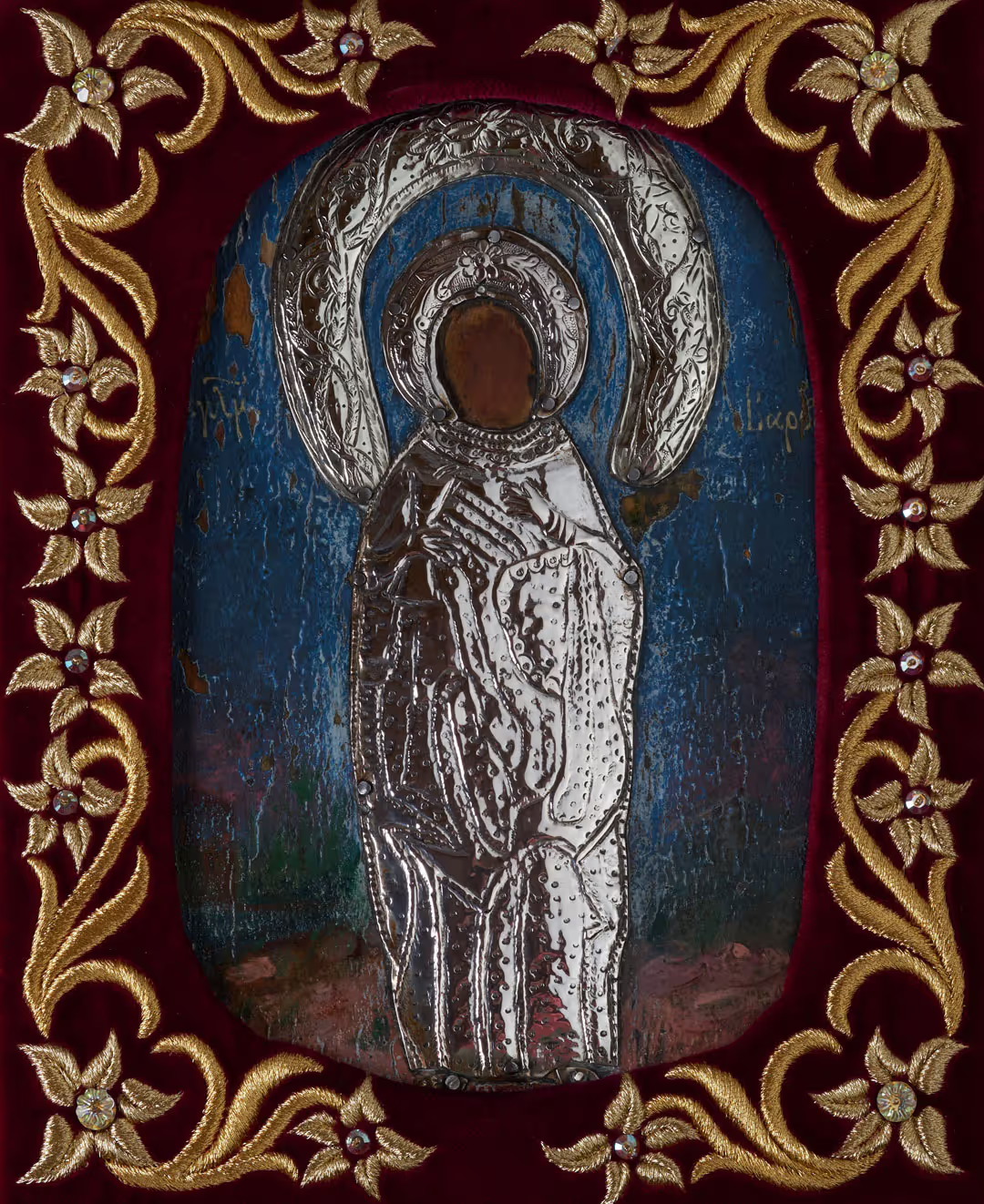
Joasaph and Maximos were subsequently canonised by the Orthodox Church, and their feast day falls on August 7th, the day after the Feast of the Transfiguration in the Orthodox calendar. A unique portable seventeenth-century icon painted in the folk style depicts the founders holding a replica of the main monastery church or katholikon that they had built. In 1975 this icon was temporarily transferred to the Monastery of Varlaam, although it was returned to Roussanou in 1995.
The work of construction begun by Joasaph and Maximos was continued by the hieromonk Arsenios, who in all likelihood succeeded them as abbot. It was under Arsenios’s rule that the wall-paintings of the Katholikon were executed by the Cretan icon-painter Tzortzis, or Zorzi. During this period a manuscript workshop was established, principally to serve the monastery’s needs.
During the 16th and early 17th centuries the monastery was at its zenith, and a great deal of restoration and renovation work was undertaken. From then onwards, however, it fell into decline. As a result of the monastery’s lack of financial resources, the monks travelled throughout Greece and beyond in order to seek donations, a practice followed by other monasteries at Meteora and those of Mount Athos.
Dwindling numbers of monks and funds continued into the 18th century. Several factors contributed to the deteriorating conditions in the area, including a burdensome administrative regime, the Russo-Turkish Wars, Turco-Albanian raids and the inclusion of Thessaly under the jurisdiction of Ali-Pasha, who increased taxation. It is probable that during this period Roussanou was completely abandoned, or maintained by only one or two monks.
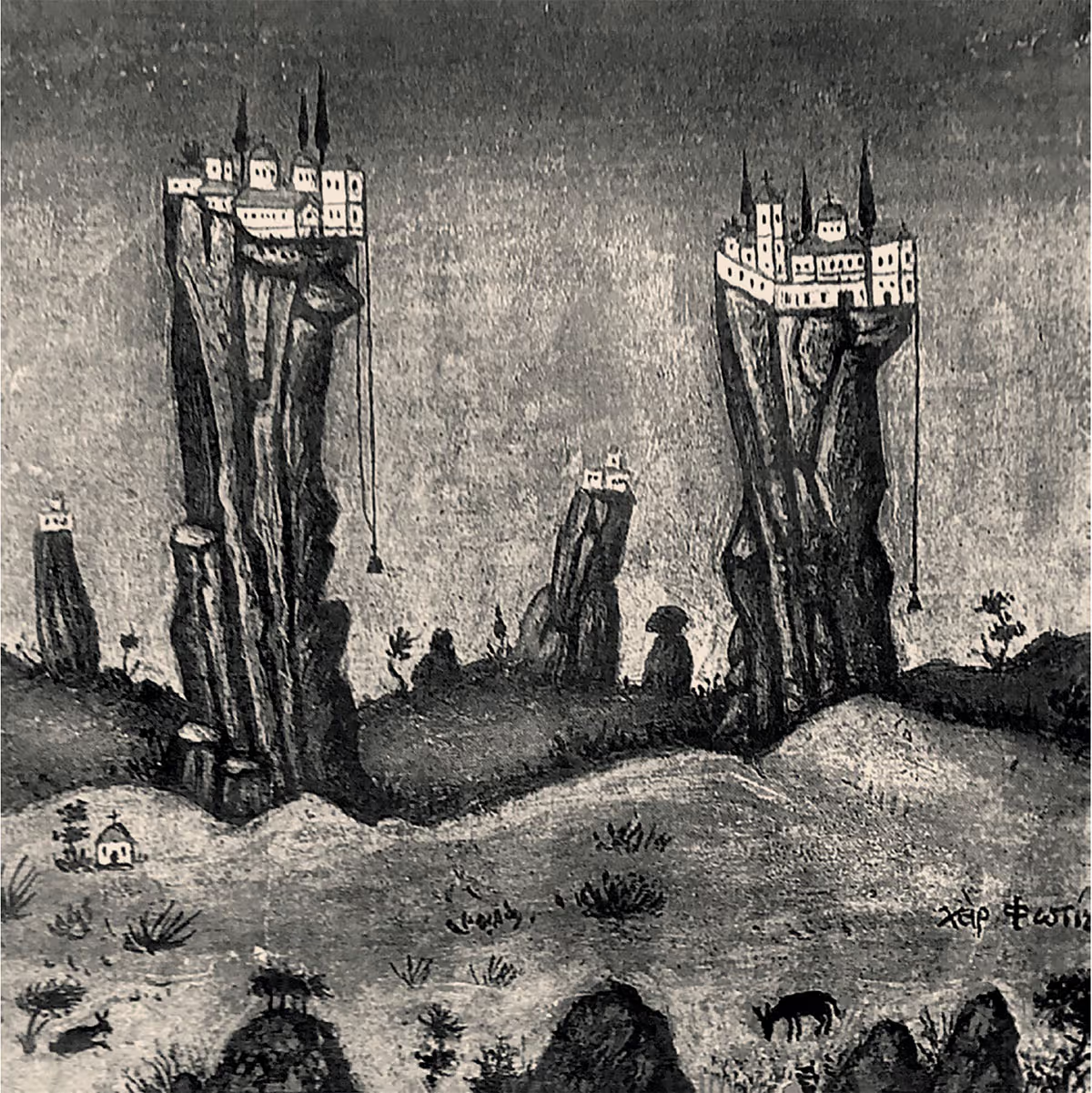
At the beginning of 1745 the Ukranian monk and traveller Basil Grigorovich-Barsky visited the monastery of Roussanou and made a sketch of it.
In the early-19th century relations between the monasteries of Meteora and Ali-Pasha worsened, especially after the unsuccessful anti-Ottoman uprising led by Thymios Vlahavas (or Papathymios) in 1808. The monasteries were ransacked during the Greek War of Independence of 1821, following the unsuccessful uprisings in the Danubian Principalities of Moldavia & Wallachia, as well as during the Epirus Revolts of 1854 and 1878 respectively.
During the 19th century several foreign travellers visited the monastery at various times, writing, in some cases, that it was inhabited by only a few, elderly monks and, in other cases, nobody at all.
On January 16th 1884, as a result of a dearth of financial resources as well as of monks, Roussanou was annexed as a metochion or dependency of the monastery of the Holy Trinity. Only essential, minor building works were undertaken by the motherhouse, which also assumed the management of Roussanou’s land.
During the Greco-Turkish war of 1897, many inhabitants of the Trikala region took refuge at the monastery.
The monastery’s greatest problem during the 19th century and up until the middle of the 20th was its lack of new recruits, with the result that it became abandoned and deserted.
A visitor to the monastery on 25 July 1927 described the two wooden bridges that provided access to the monastery as ‘worn and dilapidated’. It was inhabited by only one nun, who served as both guard and verger. The last monk, Chrysanthos Athanasiou, had died several years previously.
In 1930 two iron bridges were built as well as new steps (replacing the old and dilapidated wooden ones that dated from 1868) with funds donated by a certain Daphne Bouka, from the local village of Kastraki.
During the German Occupation in the Second World War, from 1941-1944, the deserted monastery was looted, and many of its treasures and precious manuscripts and codices were stolen, something which unfortunately was true of Meteora as a whole.
In 1950 the nun Kassiani Dimitriadou, who had been abbess of the monastery of St Gerasimos in Kefallonia, settled at the monastery together with Kyriaki Bouka from Kastraki. After Kassiani’s death on 13 August 1955, Kyriaki remained alone at the monastery, pursuing the work of reconstruction zealously, and offering warm hospitality to visitors. Not long before her death, on 26 January 26 1971, she took her vows of the megaloscheme, and was given the name Eusevia.
Shorty before Christmas 1974, on 5 December, a hieromonk from the monastery of Varlaam, Chrysostomos Tsetsios, became the abbot and the only monk at Roussanou. The work of restoration and renovation continued from then until 1985 under the supervision of the 7th Ephorate of Byzantine Antiquities. In October 1984, Archimandrite Nathaniel Katsikas, who was from the Peloponese, was appointed abbot. During his two years at the monastery he contributed towards the work of restoration. In 1986 two nuns from the monastery of the Dormition of the Mother of God at Korbovo in Langadia, lived at the monastery for a short period. The monastery subsequently remained closed during the years 1987-1988.
The main difficulty facing the various inhabitants over time was the lack of space, since the entire surface of the rock had been used up, and no further expansion was possible.
On 17 October 1988, following the model of the monastery of St Stephen, the male monastery of Roussanou became a nunnery. Eight nuns from the monastery of the Dormition of the Mother of God, known as Stagiadon, along with abbess Philothei (Kosvyra), came to settle at the monastery. Their arrival signalled the revival of the coenobitic monastic life according to the pledges and rule of the founders and a new chapter in the material and spiritual development of the monastery.
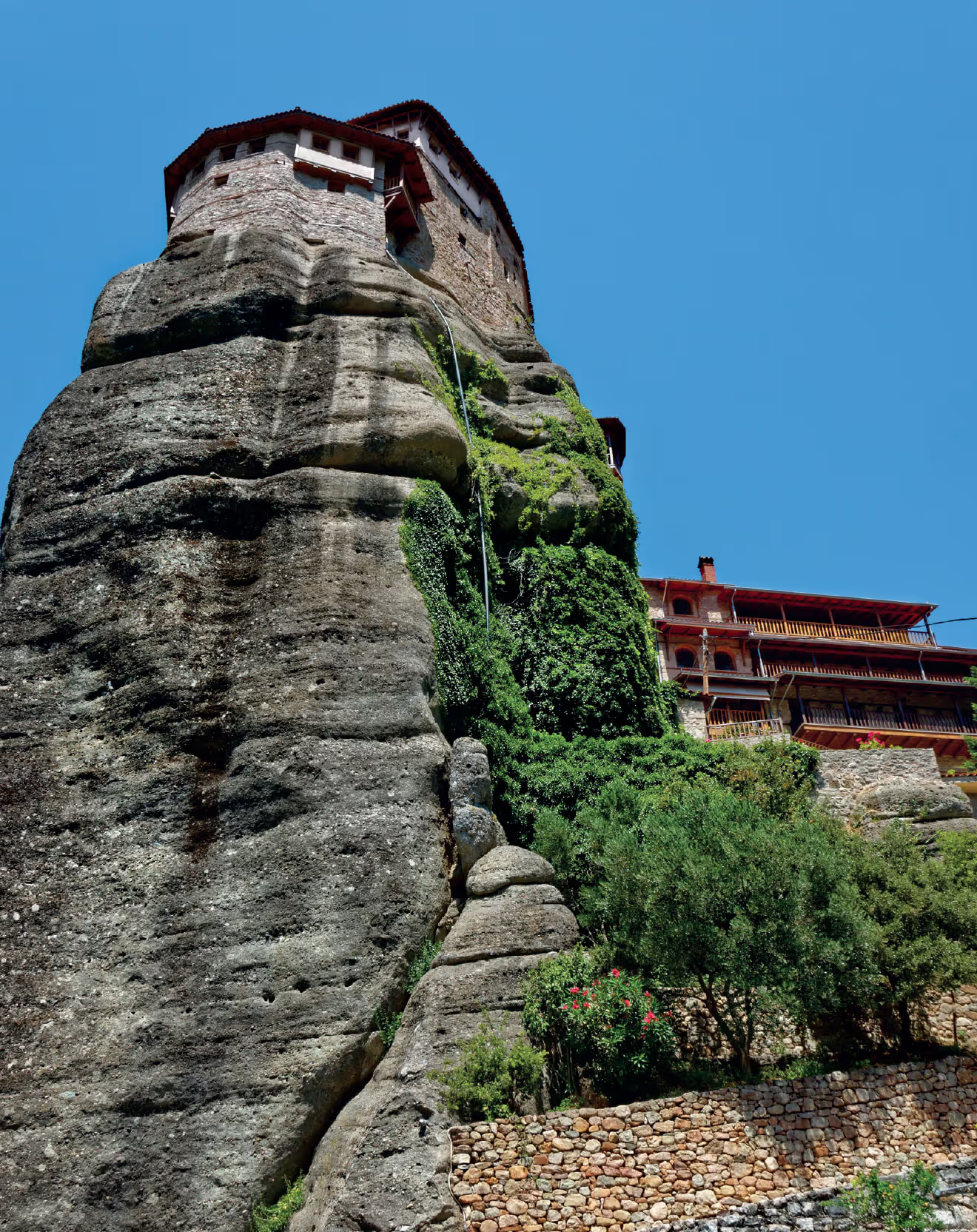
The new community of nuns immediately set about reconfiguring and renovating the dilapidated buildings. The problem of the lack of space soon became apparent. The nuns needed their own private quarters where they could pursue the contemplative life in peace, and without being disturbed by visitors. It was decided that a new wing should be built on the lower edge of the eastern side. And while the the addition somewhat altered the architectural outline of the monastery complex as a whole, it was the only solution to the lack of space, ensuring thereby the future of the community and preventing it from once again becoming deserted, like many of the other monasteries in the area.
On 22 October 1996, the late Metropolitan of Stagoi and Meteora, Seraphim, founded a new three-storey wing where the ruins of the monastery’s stable had stood. The new wing houses the chapel of the Nativity of the Mother of God, a few monastic cells, the monastery’s refectory (or trapeza) the guesthouse (or archontariki), an infirmary, a library and several workshops, where the nuns practice icon-painting, embroidery and goldwork.
The monastic community of Roussanou is deeply indebted to this venerable hierarch, the late Seraphim, who embraced the monastery with the love and benovelence of a father. The nuns greatly benefited from his spiritual guidance, and his support was instrumental in allowing the work of renovation to be undertaken.