The katholikon, the main monastery church, of the Transfiguration is a small but charming crossed-dome structure, measuring only 12.2 by 5.4 metres. As a result of limited space, the sanctuary is oriented northeast.
The cross-in-dome structure is one of the most perfect expressions of what the actual building is understood to represent. The architectural centre, that is the dome, corresponds to the centre of the church itself, and the different subjects are ordered around this centre, which is at once both the architectural and logical centre of the structure. The different elements are subject to a central scheme, which imparts the universality of the church, and they are not intended to inspire solitary, barren meditation but to create suitable conditions that enable man to be incorporated into the mystery of the Church and come closer to God.
The frescos have not been painted over and, taking into account the fact that they date from four centuries ago, are in a fairly good condition. Some damage has been caused by humidity and deterioration over time, as well as the neglect of the years when the monastery was left empty. They were cleaned of soot and restored by the state archaeological service in the 1980s.
Iconographer
The inscription above the entrance to the main church makes no reference to the name of the fresco-painter. In all likelihood this was the artist Tzortzis, or Zorzis, as revealed by research conducted on the materials and techniques used in the churches of the monasteries of Great Meteoron, Dousiko and Roussanou.
Zorzis (Giorgis) was a sixteenth-century iconographer, and one of the most important figures of early post-Byzantine art. He was pupil of Theophanes the Cretan, who influenced him stylistically.
In 1547 Zorzis decorated the monastery of Dionysiou on Mount Athos. In 1552 he came to Thessaly, where he painted the main churches of the monasteries of Great Meteoron, Dousiko (in 1557) and Roussanou (in 1560), all of which were dedicated to the Transfiguration. He returned to Mount Athos in 1568, where he painted a section of the main church of Docheiariou. In addition, apart from these churches, a number of portable icons are also ascribed to him.
A recognisable feature of his work is the preference for dark colours and intense shading in the figures of his wall-paintings, which are characterised by their austere and schematic nature, lending an intense and vigorous appearance.
The nave, the sanctuary, and the inner narthex of the katholikon of Roussanou Monastery contain some of the most magnificent frescos of post-Byzantine art of the second half of the 16th century.
The artist was clearly well-educated in theology as well as being aware of the questions and trends in the iconography of his time. He found creative ways of adapting the iconography and iconographic schemes to the limited surface space of the relatively small church. He employed traditional fresco techniques, applying the pigments to the wall surface while the plaster was still damp, which requires speed, accuracy, and skill as well as an organised team of iconographers and craftsmen.
Inner Narthex – Liti
Outside the entrance to the inner narthex there are two shallow niches on either side containing recent wall-paintings (2015) by Vlasis Tsotsonis. In the right niche we see the Transfiguration, while in the left the holy founders Joasaph and Maximos are shown.
The inner narthex is a rough square in shape (measuring approximately 4 by 4 metres) and it is covered by a single elliptical dome supported by four small round arches.
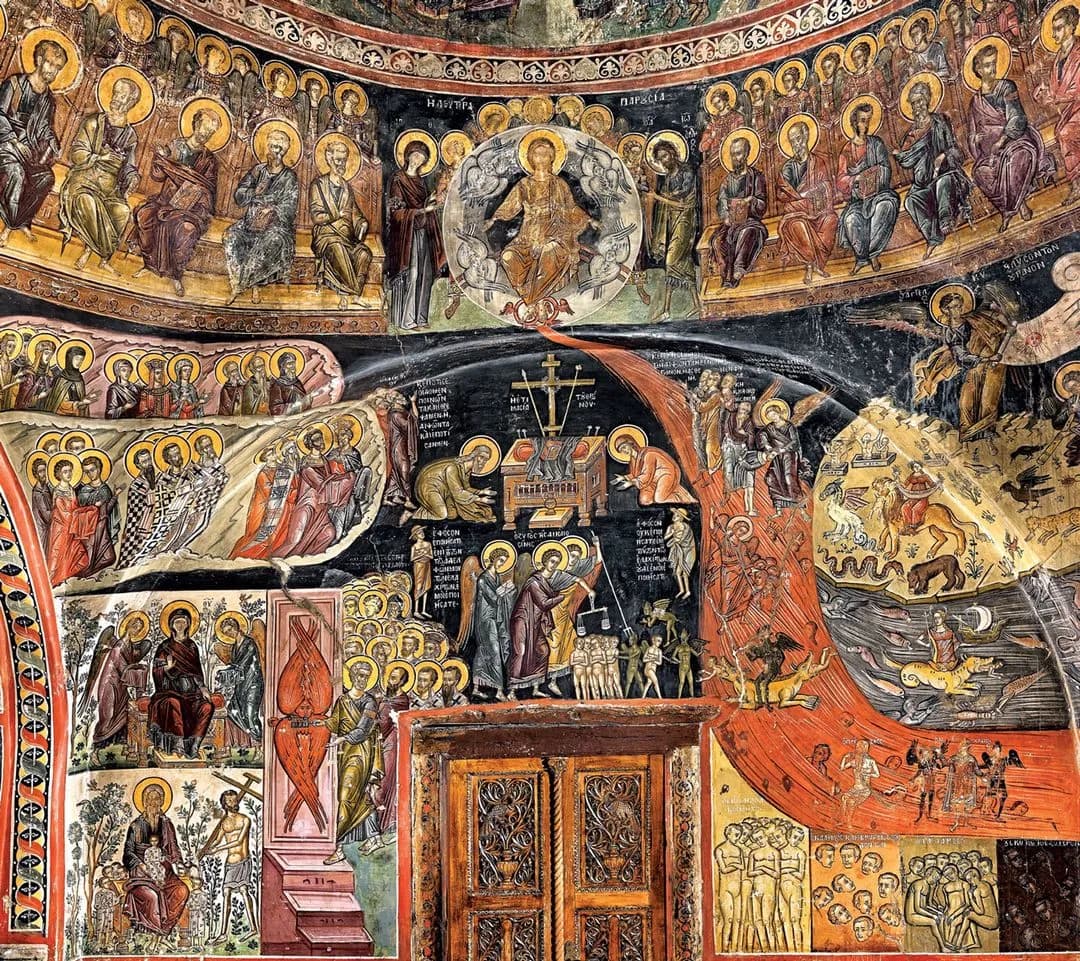
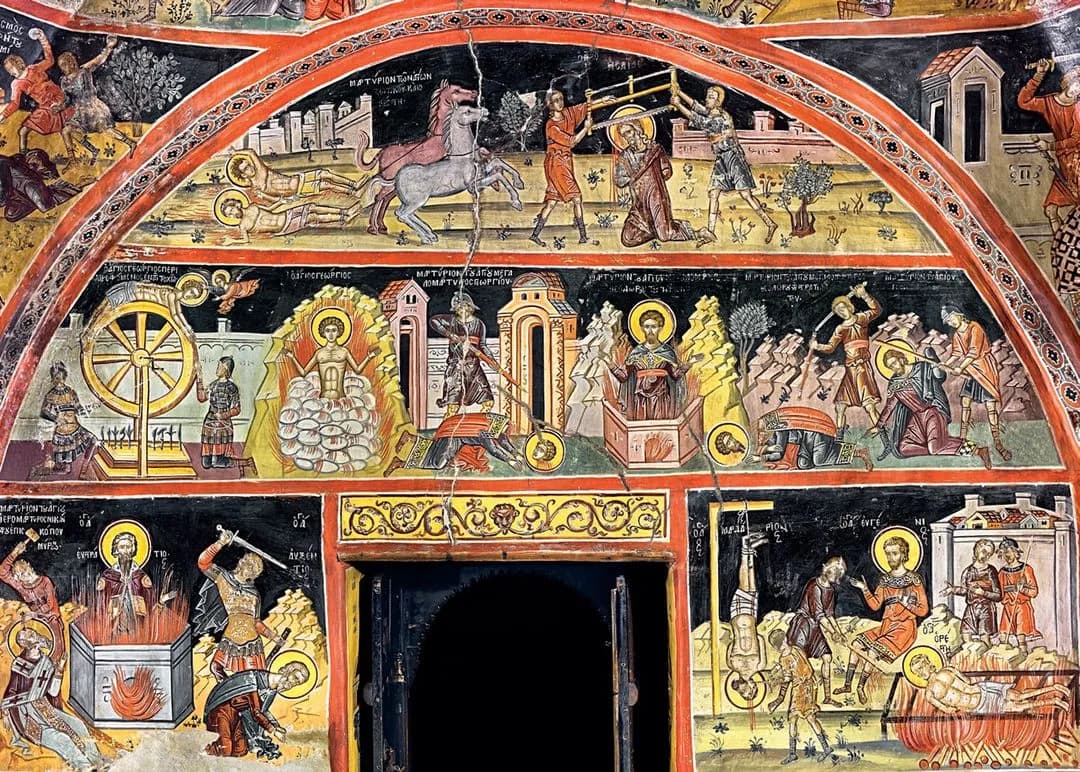
The imposing multiple-figure composition of the Last Judgment dominates the northeastern wall of the narthex. This has not of course been placed here by accident. The narthex was once used as a room for the cathechumens, that is the faithful who had not yet been baptized, and the wall-paintings have been designed with this audience in mind. The space is decorated with scenes of martyrdom to inspire the catechumens in their spiritual struggle and to provide models so that they can prepare to offer everything to Christ, even their lives.
Here it is worth mentioning that according to the rules of orthodox iconography expressions of fear and suffering are not depicted on the faces of the martyrs or cruelty and wickedness on those of the torturers. On the contrary, the martyrs appear radiant and joyful, for as they gaze at the Second Coming they realize that their suffering and sacrifice are not without reward.
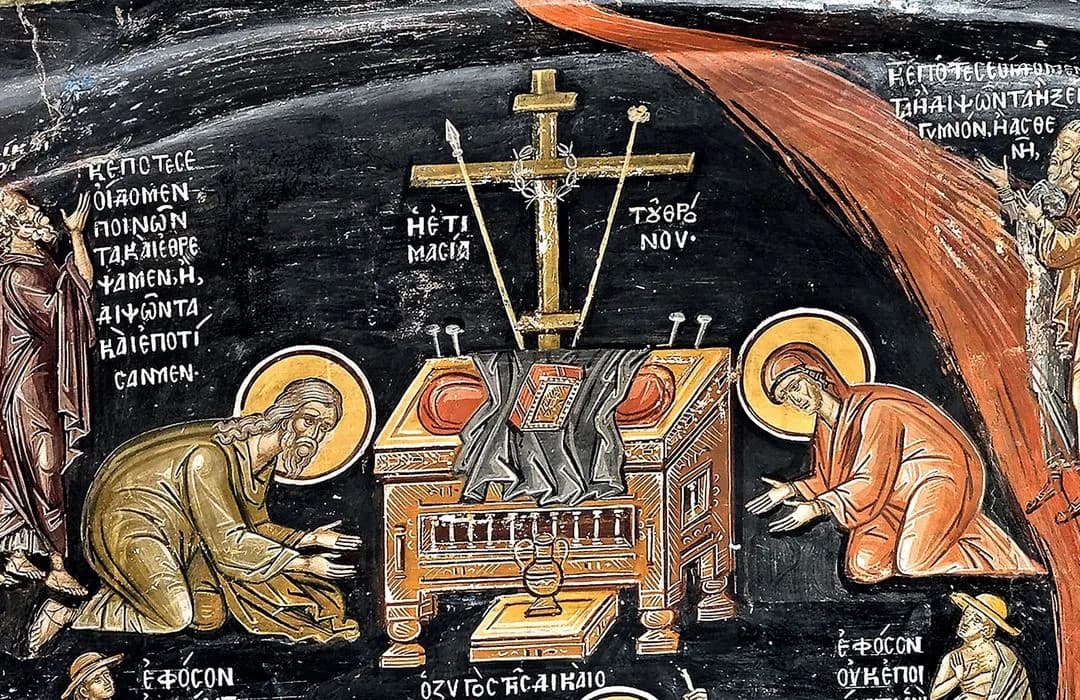
The centre of the narthex contains the fresco of The Preparation of the Throne of God, with Adam and Eve kneeling to either side. Two figures are depicted standing below the Throne. To the left stands a man who appears happy and content: this is our ‘neighbour’ whom we have helped. To the right stands a sorrowful person with his hand outstretched, who has been refused help. The illustration is accompanied by the words of Christ: “Truly I tell you, whatever you did for one of the least of these brothers and sisters of mine, you did for me…Truly I tell you, whatever you did not do for one of the least of these, you did not do for me.” (Matt 25: 40-45)
Immediately above and to the left of the Throne are painted the Righteous, with paradise on two levels below. In the first level we see the Mother of God escorted by praying angels, and in the second Abraham holding in his bosom the poor man Lazarus and the souls of the righteous, who are depicted as young children in order to signify their purity and chastity. The first to enter Paradise is the repentant thief, who was crucified alongside Christ and who said: "Jesus, remember me when you come into your kingdom." The gates of Paradise are guarded by an angel (a six-winged cherubim), and the Apostle Peter is shown opening them with the key given to him by Christ himself.
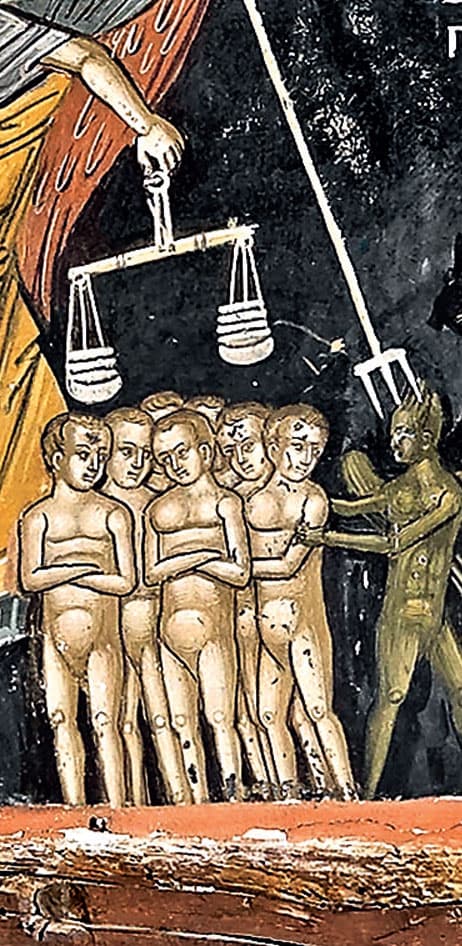
Hell and the river of fire is depicted on the right hand side, where we see both men and women, young and old, kings and monks. All the figures are representative of mankind generally, with the exception of three individuals: Arius, the fourth century theologian declared a heretic, the rich man (of the parable of the rich man and Lazarus), and the Antichrist. The emphasis is on the primary importance of right belief or orthi pisti, accompanied of course by right or good deeds (orthopraxia) and the love of one’s neighbour.
Above the river of fire there is an impressive representation of the Resurrection (the return or apodosis) of the Dead. The sea and the earth are both personified as female figures, giving back or returning the dead to life. It is the hour of Resurrecction for all people, the just and the unjust. Under the river of fire we see the everlasting punishments of hell: the worm that dieth not, the gnashing of the teeth, Tartarus and the outer darkness. Above the lintel of the door into the nave are depicted three angels: the angel in the centre bears the scales of justice, the one on the right holds a trident to push away the demons that are trying to seize the souls of people, while the angel on the left holds up scrolls upon which the good deeds of those being judged are inscribed.
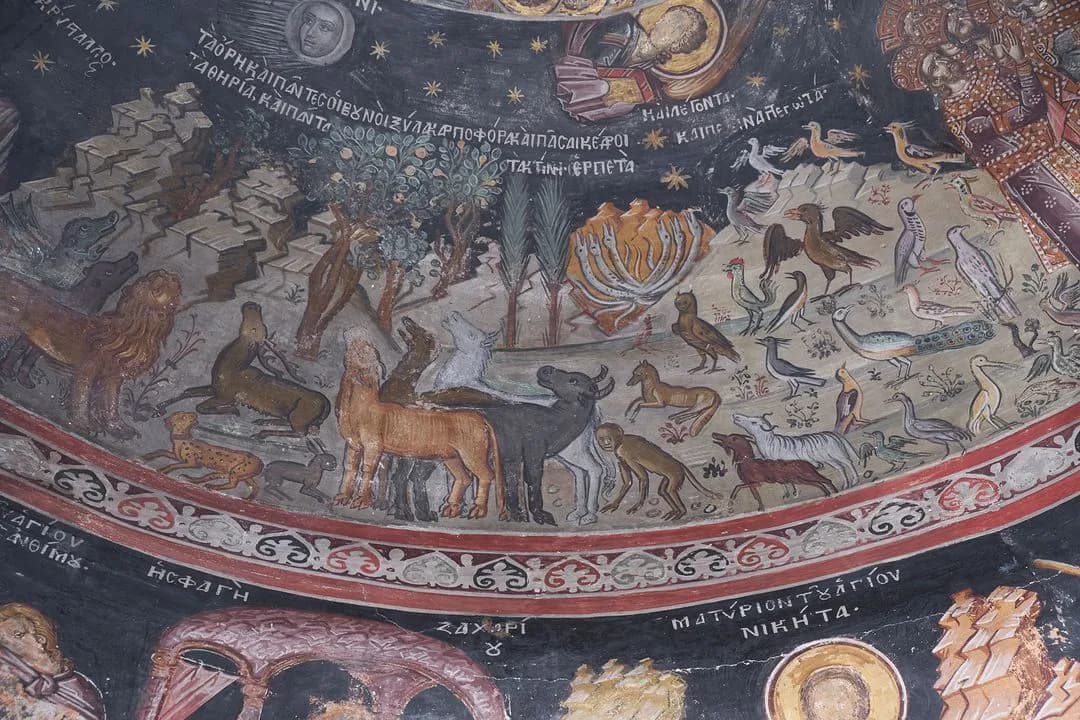
The dome contains the iconographic representaion of the Praises (Ainoi), the last three psalms of David. In the centre we see Christ Pantocrator surrounded by nine orders of angels and the symbols of the four Evangelists. All around are depicted “both young men, and maidens; old men, and children” praising and glorifying God. The psalmist presents not only people praising God, but also other elements of the created world: animals, plants, and even inanimate things such as mountains and weather phenomena (lightning and hail, snow and clouds, stormy winds). All these are skilfully executed by this exceptional iconographer. The creation, the world in its whole beauty, is ample evidence for the existence of the all-wise God.
On the remaining three walls thirty six scenes of martyrdom unfold in horizontal, superimposed layers.
To the right of the entrance to the nave there is a small portable icon of the Transfiguration, painted by a nun from the monastery, and to the left a reliquary containing the relics of Sts Barbara, Panteleimon, Prokopius and Modestos.
Nave
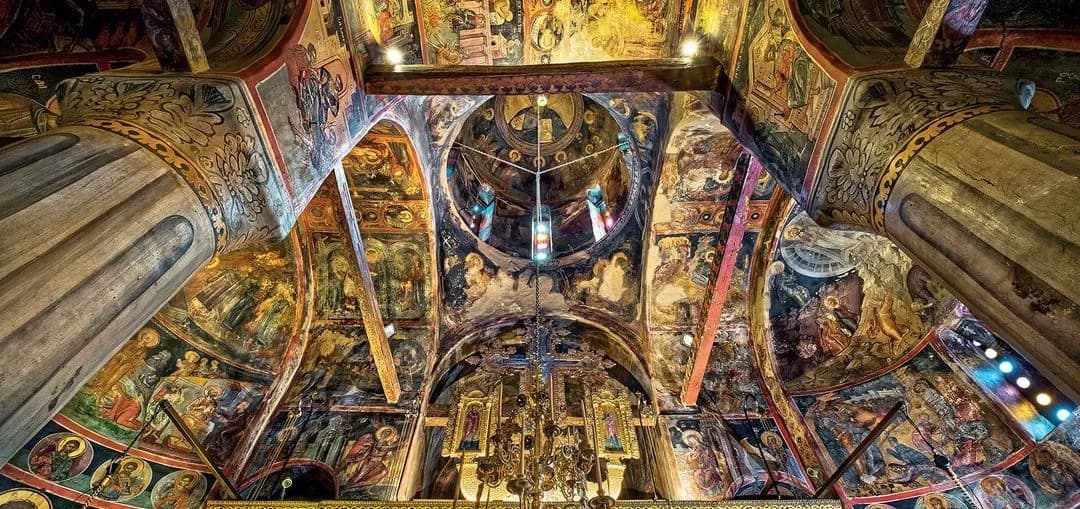
The nave of the katholikon is Athonite in style. It is designed according to the cross-in-square plan, with two main pillars and a polygonal dome supported by two columns to the West and two square columns to the East. To the southeast and northwest there are alcoves for the two respective choirs of chanters. The high polygonal dome dominates the whole monastery complex.
According to the inscription above the entrance to the nave and under the representation of the Dormition of the Mother of God, the frescos were completed in November 1560, that is thirty years after the monastery was built, at the time hieromonk Arsenios was abbot. “This venerable and holy church of our Lord and God and Saviour Jesus Christ of the Transfiguration was decorated through the contribution, labour and expense of his holiness the hieromonk and abbot of this respected monastery, the late Arsenios, during the year 1560, on the 20th of the the month of November, of the fourth indiction.” The name of the artist is not mentioned.
The iconographic scheme includes elements from the life of Christ, or Christological Cycle (Dodekaorton or Twelve Great Feasts, the Passion and Resurection of the Lord), the life of the Mother of God, or the Marian Cycle (the Nativity of the Theotokos, and the Entrance into the Temple) as well as the Hagiological Cycle (the forefathers of Christ, the Prophets, ascetics, stylites and other categories of saints).
Within the nave, and above the main door, we see the multi-figure composition of the Dormition of the Mother of God. In the centre lies Mary, and behind her stands Christ receiving her soul, which is represented as an infant. They are surrounded by a multitude of angels, apostles, saints and the faithful in mourning. On either side are depicted two hymnographers (or melodists), Bishop Cosmas of Maiuma and St John of Damascus, who both composed the celebrated hymns for the services of the Feast of the Dormition.
To the right and left of the holy doors we see the full-length figures of the Archangels Michael and Gabriel of the Higher Heavens, standing majestically like vigilant guards.
Iconostasis
Only two sections of the tall iconostasis that separates the nave from the sanctuary survive: the upper part, containing icons most probably by the church’s iconographer, and the old Holy Doors, which are decorated with a representation of the Annunciation. The lower part, which was stolen sometime before 1974, when the monastery lay empty, was replaced by a modern construction in 2017.
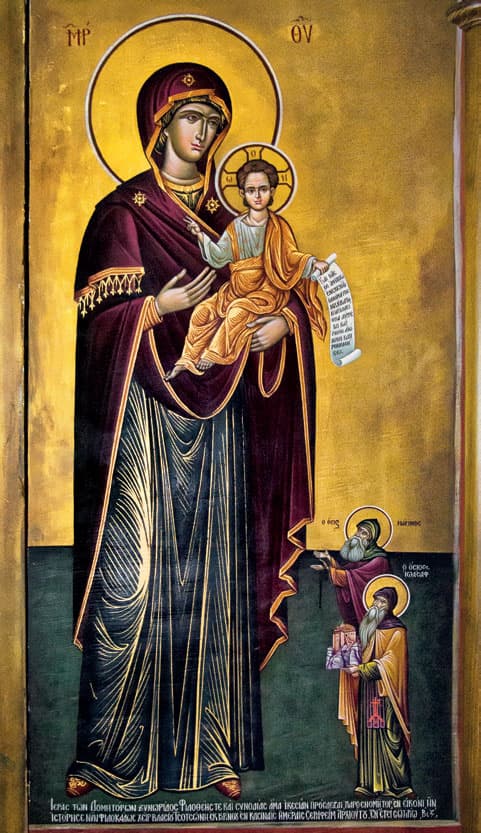
That same year, Vlasis Tsotsonis decorated the north-eastern square pillar of the katholikon with a representation of the Mother of God and the two founders, Joasaph and Maximos, devoutly offering her a replica of the monastery they had built, allowing the nuns to to bring to mind the inspired words on the coenobitic life of the holy founders: “all shall be united in love and truth as one soul that fits many bodies and not many minds.”
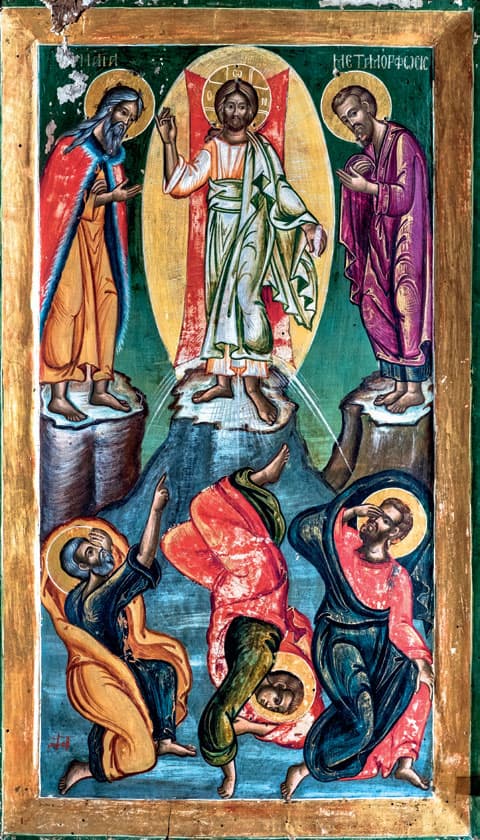
The iconostasis carries two icons of Jesus Christ painted in 1799 by the iconographer Konstantinos from Pyli: the half-length image of Christ holding an open Gospel and raising his hand in blessing, and the Transfiguration of the Saviour. The icons are signed with the Roman characters: ‘K at Porta,’ meaning Konstantinos from Porta, i.e. the village of Pyli in the prefecture of Trikala. The icon of St John the Baptist, represented as an angel, is by the same artist.
Sanctuary
In the sanctuary, where the mystery of the Eucharist is held, the iconography is of a fitting dogmatic and Eucharistic nature.
In a space next to the Prothesis we see the fresco of a monk; he has no halo is depicted kneeling and censing. This is thought to represent the priest-monk Arsenios, who served as abbot in the mid-16th century and whose name is given as the founder of the church in the inscription above the entrance.
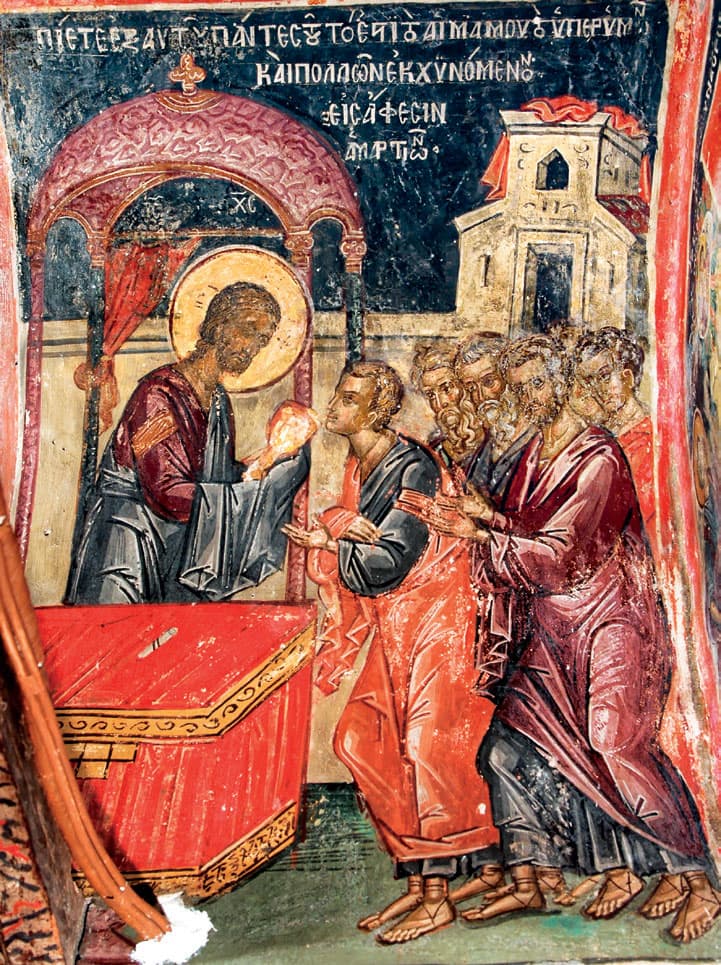
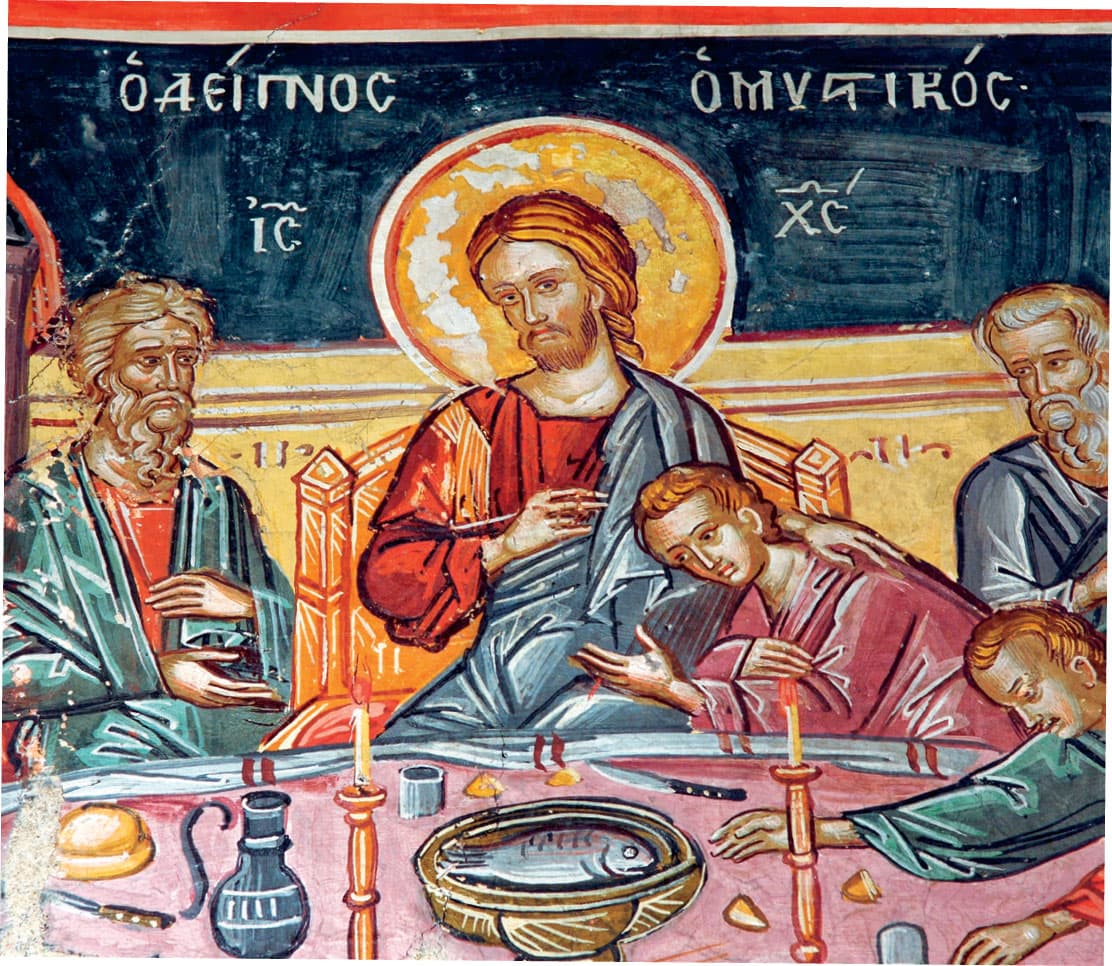
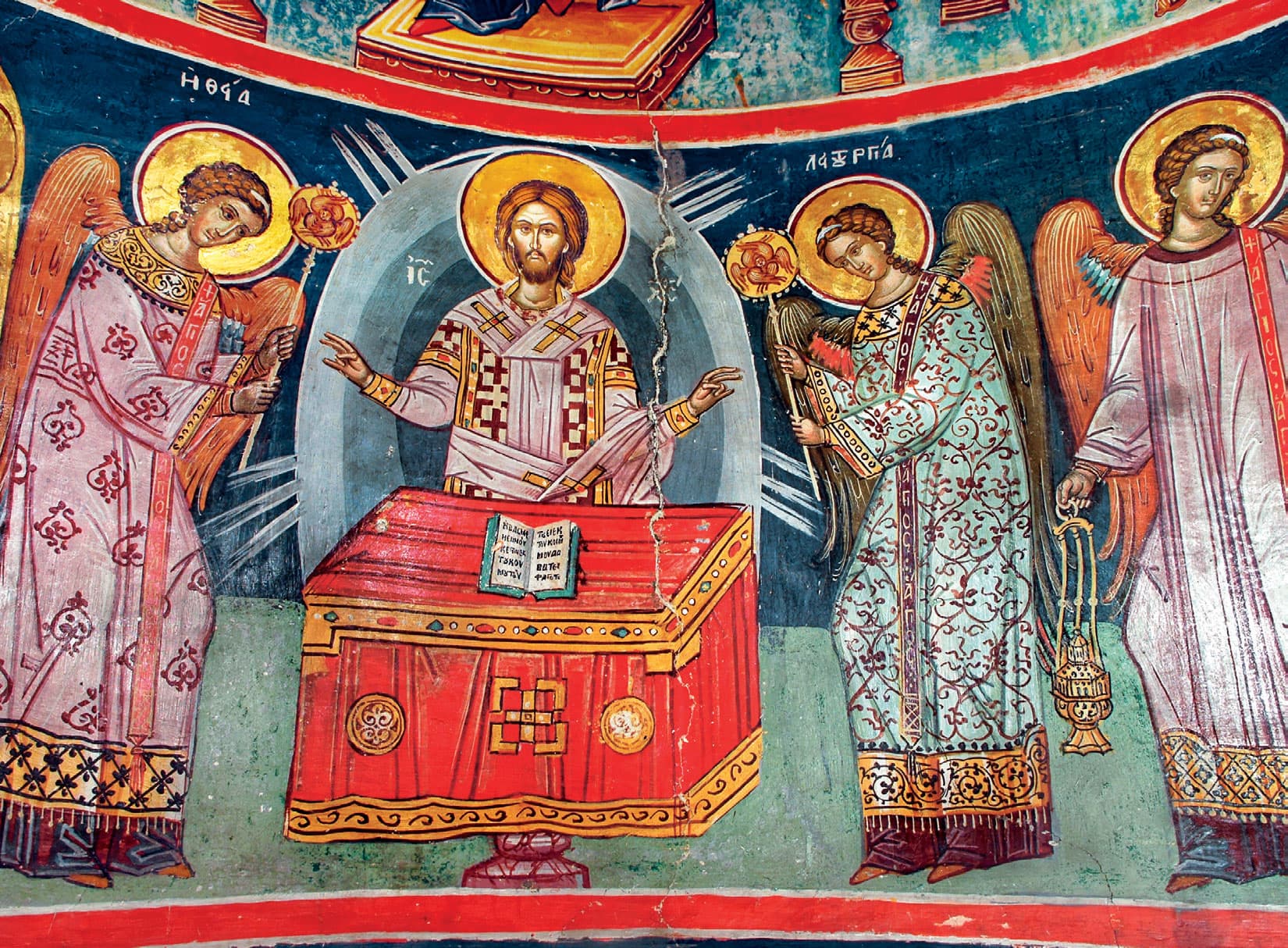
Sanctuary frescoes: Eucharistic cycle.