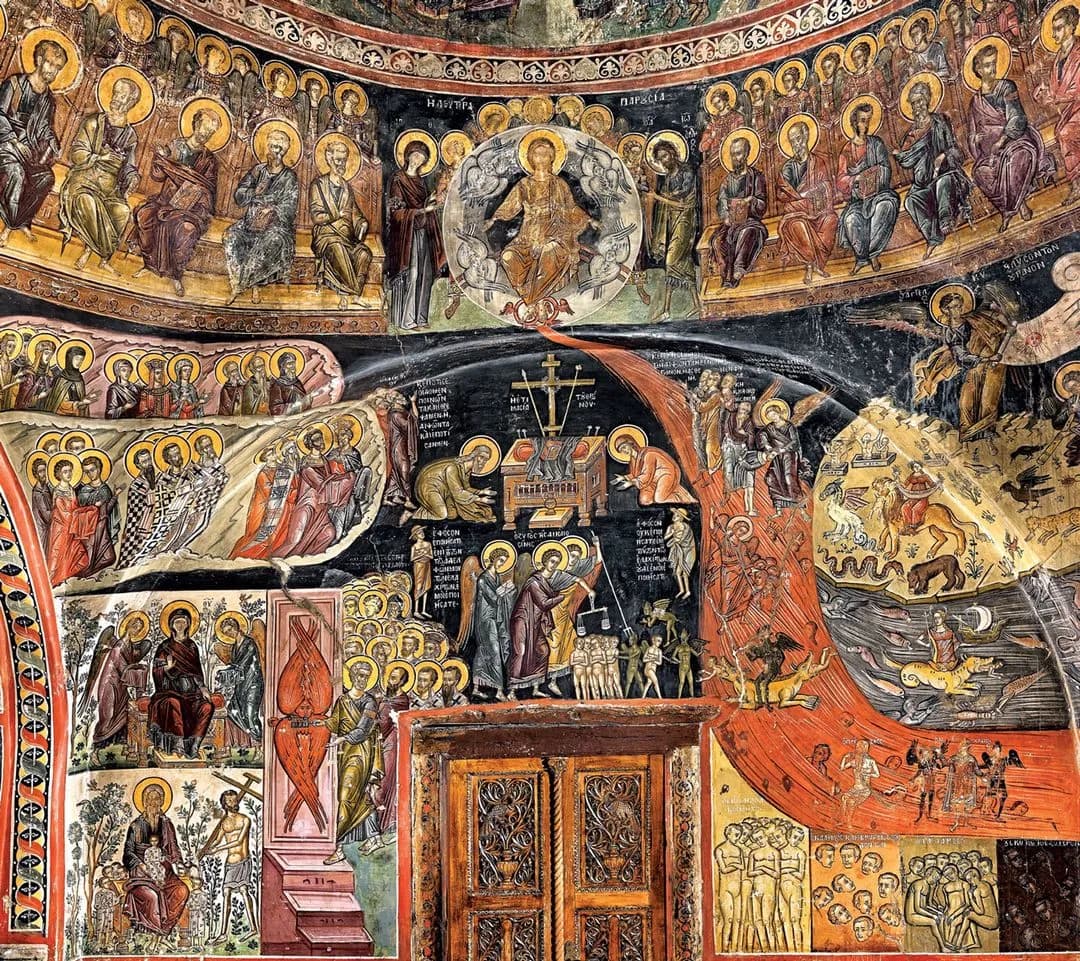
An orthodox church is designed to be a micro-image of everything in the visible and invisible universe. According to St Symeon of Thessalonica a church is an image of the Holy Church, and represents everything on heaven and earth. The iconographic decoration should encompass all the elements that make up the Church: Christ, its leader and head, in the centre of the dome; the prophets, who prepared the world for Christ’s coming; and the Evangelists, who linked heaven and earth through their word – which explains why they are depicted on the four points that connect the dome with the rest of the building; and the martyrs and the saints in the lowest band, almost at a level with the congregation, as it were to stand beside and advise the worshippers. Nothing is placed at random. Quite the contrary: everything has a meaning and purpose, so that all the elements blend together in a unified whole and reveal that one is in a sacred place.
All orthodox churches are decorated with iconography. Before describing the monastery’s katholikon it would be useful to give a short introduction to Byzantine iconography.
Orthodox iconography is the visual language of the church. As a form of communication, it could be said that it shares elements in common with modern art, in that it is not an imitation of optical phenomena, but it is an expression of man’s spiritual quest. The etymology of the word icon (eikona) derives from the verb eiko, meaning to resemble (omoiazo). According to St Basil the Great, the nature of the icon is to imitate the Archetype. The icon is a vehicle for the word of God. ‘Just as the word of Scripture is an image, so is the painted image a word,’ writes the iconographer and art historian Leonid Ouspensky in his book Theology of the Icon.
For the faithful, an icon is not a mere work of art, but it is considered a sacred vessel, which sanctifies man and brings him into direct relation with the person who is portrayed.
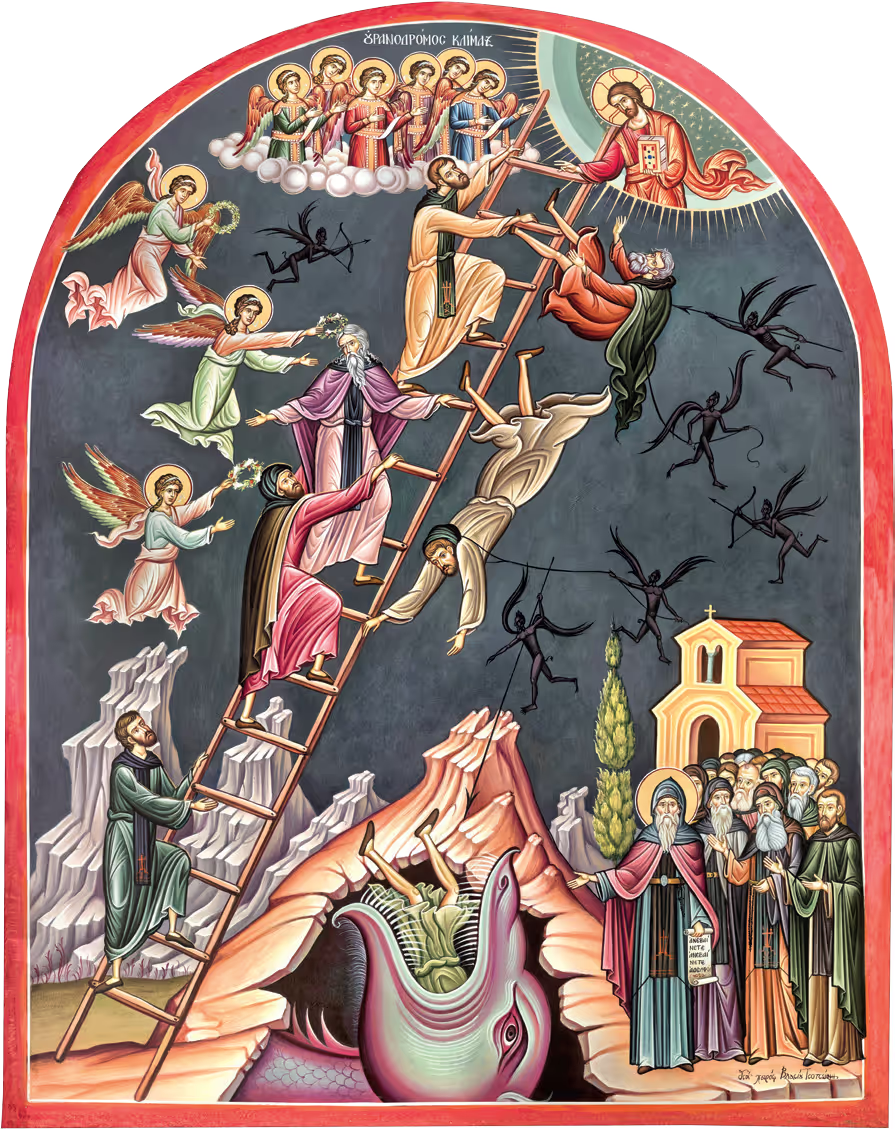
When we look closely at a byzantine icon, we can see that space, objects and figures are not represented in a naturalistic manner. Perspective appears to be free of restrictions and depth is absent. Natural forms and the colours are transformed in order to express another, spiritual, reality. The light is internal and it is diffused without creating shadows, in a mystical way, for figures and objects do not appear to be lit up by external sources of light. The schematic and frequently geometrical manner of drawing betrays the sense of the unearthly and the sacred. The austerity and the simplicity detach our mind from all that is earthly and superfluous, focusing our attention on an immaterial reality. The unworldly beauty of an icon, created according to these principles, confounds our sense of things and leads us to the realm of original beauty.
The frescos in the churches of Meteora were painted by iconographers of the Cretan School, which reached its zenith in the sixteenth century. The iconography of this School is marked by simplicity and austerity, and a mystical and ascetic character. The colours are limited in range and they are combined to create a sense of serene harmony. Byzantine iconography exudes a sense of tremendous dignity, devoutness, reverence and solemnity. It is an art of subtle spiritual sentiments and of the inner life. The scant light seems to spring from a deep source. It is known as teh monastic art.